



What Are AI Agents in CRM and How Creatio Uses Them

Artificial Intelligence in CRM is entering a new phase.
After several years in which AI was mainly used to generate content, summarize information, and provide recommendations, the next stage is moving toward AI that can take action and carry out work more autonomously.
This shift is visible in the growth of Agentic AI in enterprise software. Gartner predicts that by 2028, 33% of enterprise software applications will include Agentic AI, up from less than 1% in 2024.
However, rising adoption does not automatically mean every implementation will deliver business value. Gartner also predicts that more than 40% of Agentic AI projects will be canceled by the end of 2027, largely due to escalating costs, unclear business value, and inadequate risk controls.
These two projections illustrate both sides of Agentic AI's growth: the potential is large, but implementation requires the right use case and governance.
In CRM, this shift is becoming increasingly relevant. CRM is no longer just a place to store customer data and log activity. With AI Agents, CRM can now help understand context, determine the next step, and even carry out certain activities within a workflow.
This approach is becoming known as Agentic CRM.
Creatio is one of the platforms developing this approach by integrating AI Agents into its CRM and workflow platform.
So what exactly is an AI Agent in CRM, how is it different from a chatbot or ordinary automation, and how does Creatio use it across sales, marketing, and customer service?
What Is an AI Agent in CRM?
Simply put, an AI Agent in CRM is an AI-based system that can understand context and goals, then determine or carry out actions to help complete work within a CRM process.
While Generative AI is typically used to produce a specific output, such as drafting an email or summarizing information, an AI Agent is designed to go further.
In a CRM context, an AI Agent can be used for activities such as:
1. Analyzing customer and account data
2. Gathering relevant information
3. Recommending the next action
4. Creating or updating CRM records
5. Preparing customer communication
6. Helping execute activities within a workflow
7. Coordinating multiple stages of work
8. Following up based on specific conditions
In other words, AI is shifting from simply providing information to actively taking part in the work.
This matters because most customer operations are not made up of a single activity. Sales, marketing, and customer service typically involve a combination of data, decisions, communication, and action.
An AI Agent Is Not Just a Chatbot or Automation
An AI Agent is sometimes equated with a chatbot, an AI assistant, or ordinary automation. In reality, each serves a different function.
Rule-based automation executes an action when a certain condition is met. Example: Lead comes in → assigned to sales → notification sent.
Generative AI can help produce something based on a prompt, such as drafting a follow-up email.
An AI Assistant can provide context-based help, such as summarizing customer history before a meeting.
An AI Agent can go further by understanding the goal, using available context, determining the necessary steps, and carrying out actions within the access it has been granted.
The difference can be illustrated as follows:
Approach | Main Focus | Example in CRM |
| Rule-Based Automation | Executing predefined rules | Assigning a lead when certain criteria are met |
| Generative AI | Generating content or insight | Drafting a follow-up email |
| AI Assistant | Helping users get work done | Summarizing customer history before a meeting |
| AI Agent | Determining and executing actions within a workflow | Analyzing an account, preparing for a meeting, and helping carry out the next action |
The difference lies not only in how intelligent the AI is, but in how far it can participate in the business process.
From a CRM That Stores Data to a CRM That Can Act
Traditional CRM relies heavily on user activity.
A sales representative, for example, needs to open the account record, read the interaction history, check the opportunity, decide on priorities, follow up, and then update the CRM again.
The information may already be available, but people still have to do a lot of work to turn that information into action.
With AI Agents, this pattern is starting to change.
Traditional CRM - Data → User searches → User analyzes → User decides → User acts
Agentic CRM - Data + Context → AI analyzes → AI recommends / executes action → Human oversight
This means CRM is gradually evolving from just a system of record into a system that can also help drive action.
However, the level of autonomy does not need to be the same for every process. High-risk decisions may still require human review or approval.
Opportunity vs Implementation Reality
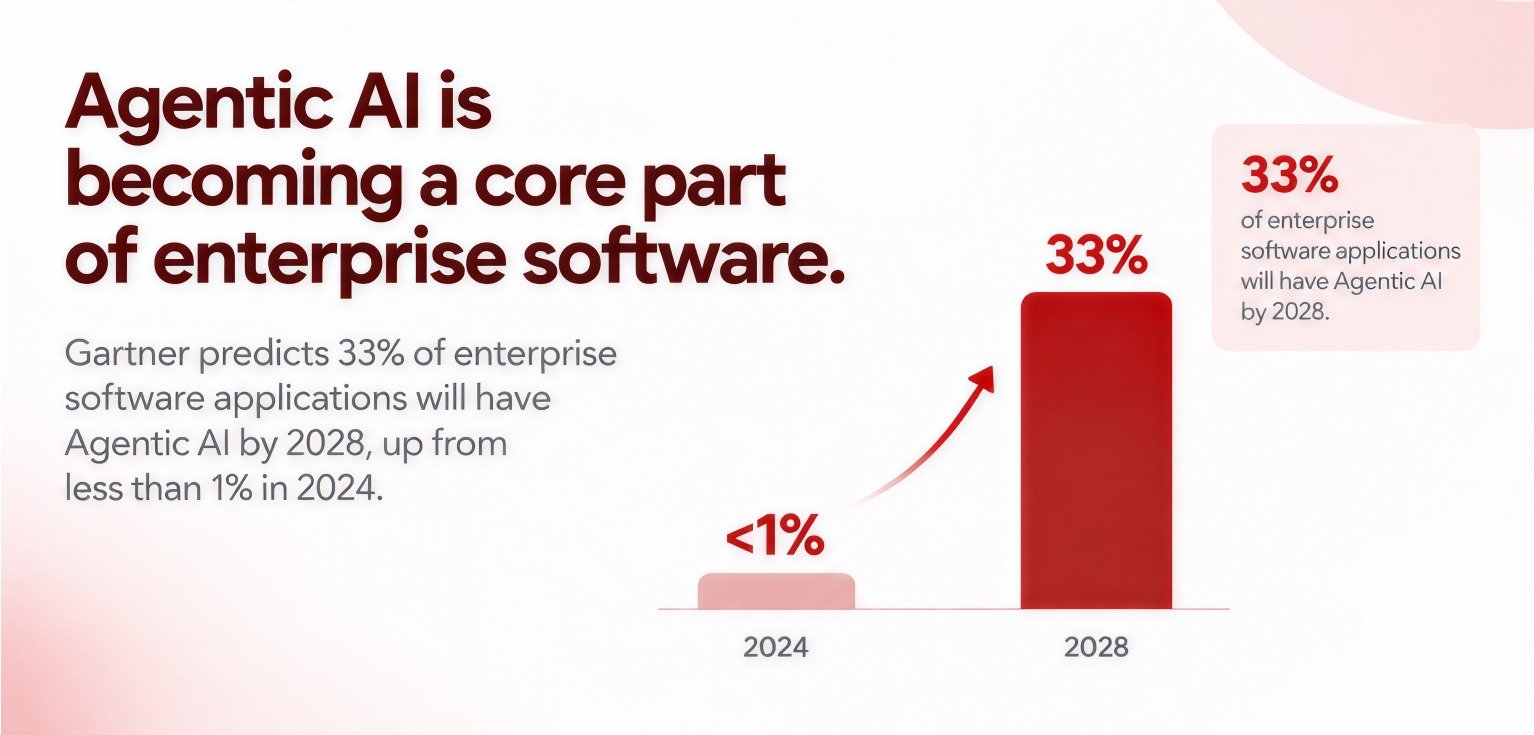
Source: Gartner
These two figures provide important context: adopting an AI Agent is not the end goal in itself.
How Does Creatio Use AI Agents?
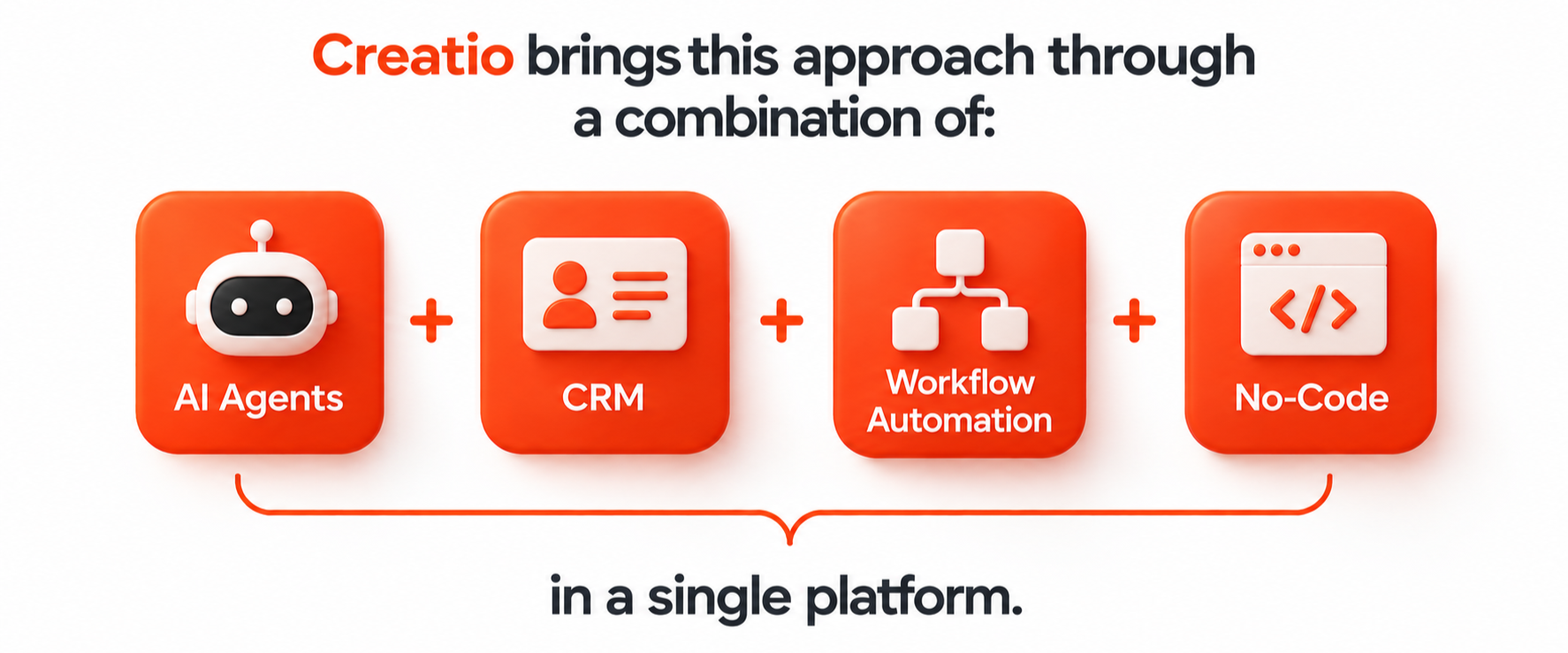
Creatio has developed an AI CRM approach in which predictive, generative, and agentic AI sit within a single platform architecture.
In Creatio's approach, AI is not simply added as an extra chatbot layered on top of CRM. Creatio states that its AI architecture can natively understand CRM objects, workflows, relationships, and business context.
As a result, an AI Agent can work using the context of the process already in motion.
Creatio also combines this capability with no-code tools, allowing organizations to use pre-built agents while also developing and customizing agents for specific workflows.
In simple terms, how it works can be described as:
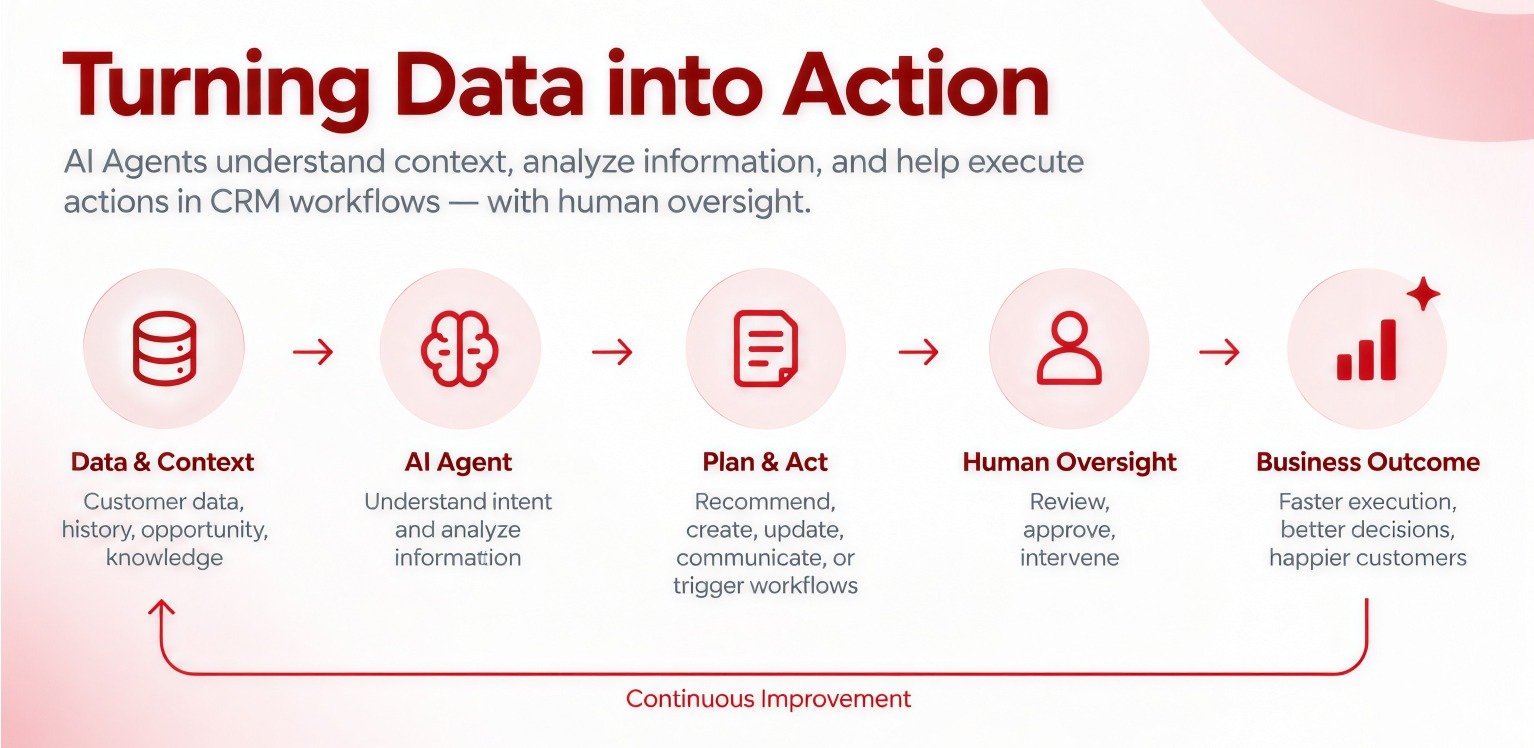
Creatio supports a human-in-the-loop approach, allowing organizations to set the AI's level of autonomy according to what each process requires.
AI Agent for Sales
Sales is one of the areas where the use of AI Agents is most directly visible.
Sales representatives do not only spend time talking to customers. There is a lot of work behind the scenes: finding account information, preparing for meetings, updating the CRM, creating quotations, following up, and deciding which opportunities to prioritize.
Creatio provides a number of AI Agents for sales activities, such as: Account Research Agent; Meeting Preparation Agent; Quote Generation Agent; Forecast Agent; Territory Management Agent; Next Best Action Agent; CRM Data Update Agent; Lead Scoring Agent.
For example, before meeting a customer, the Meeting Preparation Agent can help prepare the context and information needed based on available data.
The Account Research Agent can help enrich account information, while the Next Best Action Agent can help recommend the next step.
The goal is not to replace a salesperson's ability to build relationships or negotiate.
Instead, AI can take on part of the information-gathering and administrative work so sales can focus more on tasks that require judgment and human interaction.
AI Agent for Marketing
Marketing also has workflows that involve a lot of data, content, and repeated decisions.
This ranges from defining the audience and creating communications to running campaigns and qualifying leads.
In Creatio Marketing, some of the available AI Agents include: Marketing Content Agent; Email Generation Agent; Campaign Agent; Lead Scoring Agent; Lead Distribution Agent.
Its use can include creating and personalizing content, scoring and qualifying leads, and helping distribute leads to sales.
Creatio also integrates AI with customer profiles and segmentation, so customer data can be used as context within the marketing workflow.
Here, an AI Agent does more than help produce content. Its greater potential lies in connecting data → decision → execution within the marketing workflow.
AI Agent for Customer Service
Customer service has different needs.
Service agents need to understand customer history, identify the issue, find relevant knowledge, set priorities, and respond quickly.
Creatio provides AI Agents for use cases such as: Customer Support Agent; Knowledge Base Agent; Case Classification Agent; Service Playbook Agent; Next Best Action Agent.
For example, AI can help classify cases and provide context to service agents before they handle a customer.
The Knowledge Base Agent can help use and manage the information needed to resolve a case.
In scenarios like this, AI becomes the intelligence layer that connects customer data, knowledge, workflow, and the service team.
Talk to us about your CRM needs with our Creatio AI CRM solution, free of charge!
No-Code Makes AI Agents More Flexible
One of the things that sets Creatio's approach apart is the combination of Agentic AI and no-code.
Companies are not limited to relying on pre-built AI Agents.
Through no-code capabilities and AI Studio, organizations can build, customize, test, and manage agents based on their process needs using visual tools and natural language.
This matters because every organization's workflow is different.
A B2B company's lead qualification process, for instance, can differ from that of a financial services company. The same applies to customer onboarding, approvals, service escalation, or other processes with their own business rules.
With this approach, companies can adapt AI Agents to their existing workflows without turning every change into a traditional development project.
That flexibility, however, still needs to be paired with governance.
From Human Workflow to Human + AI Workflow
The biggest implication of AI Agents is not really about any single feature.
The more fundamental change is in how companies design their workflows.
Previously, digital workflows generally took the form: Human → System → Human → System
With AI Agents, a new participant emerges: Human → AI Agent → System → AI Agent → Human
Some activities still require a human. Some can be assisted by AI. Certain routine activities, meanwhile, can be run more autonomously.
For simple, predictable processes, rule-based automation may already be enough.
An AI Agent becomes more relevant when the work requires a combination of context, reasoning, decision, and action.
Governance Becomes as Important as Automation
Gartner's prediction that more than 40% of Agentic AI projects could be canceled by the end of 2027 is a reminder that technological capability alone does not guarantee successful implementation.
The further AI is able to take action, the more important it becomes for an organization to define the limits of its authority.
There are at least five areas worth paying attention to:
1. Data Quality
AI Agents need reliable data and context. Automation does not automatically fix incomplete or inaccurate data.
2. Access & Permission
Organizations need to define what data each agent can access and what actions it is allowed to take.
3. Guardrails
There must be clear limits on the decisions and actions AI is allowed to make.
4. Human-in-the-Loop
Not every decision should be made autonomously. Certain activities still require human review or approval.
5. Monitoring
Organizations need visibility into how AI is used, what agents are doing, and their impact on business processes.
In Creatio, AI can be managed through the AI Command Center, which provides a centralized environment for managing AI Agents, access, usage, and deployment.
Will AI Agents Replace Sales, Marketing, or Customer Service Teams?
This question oversimplifies the change that is actually taking place.
In many CRM workflows, an AI Agent is more accurately seen as a digital participant in the work process, not a replacement for an entire role.
AI is relatively well suited to activities such as: Search → Analyze → Summarize → Recommend → Execute Routine Action
Meanwhile, humans still play an important role in activities that require: Judgment → Relationship → Negotiation → Creativity → Accountability
Because of this, the value of Agentic CRM does not have to come from removing people from the process.
Value emerges when an organization can determine which parts should be done by people, which parts AI can help with, and which parts are worth automating.
Key Takeaways
AI Agents mark an important shift in the evolution of CRM.
CRM is no longer just a place to store customer information or run predefined workflows. Agentic AI allows CRM to start understanding context, giving recommendations, and carrying out certain actions within a business process.
However, the development of Agentic AI also shows that more automation does not always mean more value.
The success of implementation will depend heavily on choosing the right use case, data quality, workflow design, governance, and the right division of roles between humans and AI.
Explore How AI Agents Can Be Used in Your CRM
Every organization has a different customer journey, workflow, data, and governance needs. Not every process needs autonomous AI, and not every use case requires the same level of autonomy.
Talk to Indocyber about your CRM and business workflow needs to explore how Creatio and AI Agents can be applied to fit your organization.
[ Discuss Your Needs ->Creatio ]
Follow the latest developments in CRM, AI, automation, enterprise technology, and digital transformation through the latest insights from Indocyber.