

From Digital Documents to Manual Approvals: Why the Gap Still Exists
Many companies have digitized their documents. Contracts are created in electronic format, documents are shared through systems, and various administrative processes no longer depend on paper.
However, a digital document does not automatically mean the entire process around it is already running digitally.
Within the approval process, certain stages can still run separately. Documents move from one party to another, the signing itself happens through a different mechanism, and information about signing activity often has to be traced back manually whenever it's needed.
This situation points to an important distinction between document digitization and process digitization.
Digital transformation isn't only about changing a document's format. Companies also need to look at how that document gets approved, signed, verified, and managed throughout the business process.
A Digital Document Doesn't Automatically Create a Digital Process
Turning a physical document into a PDF is one step toward digitization. But the business process doesn't stop once a document has been created electronically.
A contract, for example, still has to go through approval and signing before it can be used.
This is the stage where companies need to check whether the digital process they've built already covers the signing activity, or whether signing still runs as a separate process.
This matters because signing isn't just the act of placing a signature on a document. In a business process, companies also need to consider the identity of the signer, the integrity of the signed document, the signer's consent, and the ability to trace back the signing activity.
In other words:
Document digitization changes the format. Process digitization also has to account for how that document moves and gets approved.
Signing Is a Critical Part of the Approval Process
In a conventional process, signing is often placed as the last step, after a document has already received approval.
When the process moves to digital, the same approach isn't enough if it just replaces a wet-ink signature with an image or a scanned copy of one.
There's a difference between an image of a signature on a digital document and an Electronic Signature (TTE) process, which has a mechanism linking the act of signing to the identity of the signer and the electronic information being signed.
In everyday business language, the term Digital Signature is more commonly used. In Indonesian regulation, however, the term used is Certified Electronic Signature (TTE).
Government Regulation No. 71 of 2019 (PP No. 71/2019) states that Certified TTE functions as a tool to authenticate and verify:
- The identity of the signer
- The integrity and authenticity of the Electronic Information
That regulation also sets requirements for TTE, including that any change to the Certified TTE or its related Electronic Information after the time of signing must be detectable.
In other words, when a company digitizes its signing process, what matters isn't only whether a document carries a signature, but also whether the identity, document integrity, and approval behind it can be accounted for.
Four Aspects to Consider in Digital Signing
A Certified Electronic Signature uses an Electronic Certificate issued through an Indonesian Electronic Certification Authority (PSrE).
In the context of the signing process, there are four aspects that can help a company strengthen its control over digital documents.
1. Identity: Verifying the Signer's Identity
The signing process needs to be traceable to the party who actually performs the signing.
Through identity verification and validation, a Certified Electronic Signature helps confirm the identity of the user performing the signing using their electronic certificate.
This provides a stronger basis than simply placing a signature image on a file.
2. Integrity: Preserving Document Integrity
A document can pass through several parties before and after it is signed.
Because of that, a company needs to make sure the information that has been signed stays intact.
An Electronic Signature includes a mechanism that makes any change to the every related electronic information, after signing, detectable.
This gives a company stronger control over the integrity of documents that have already been signed.
3. Consent: Strengthening Proof of Approval
A signature, in a business process, fundamentally represents a party's consent to a document.
Because of that, the digital signing process also needs to connect the act of signing with the consent of the party involved.
A Certified Electronic Signature can help strengthen the evidence that signing was carried out with the signer's consent.
4. Auditability: Making Signing Activity Traceable
Digitization also needs to provide the ability to look back at what happened, whenever that's needed.
Monitoring, tracking, and auditing within the signing process give a company traceable information about activity throughout the process and the certificate lifecycle.
Auditability becomes important when a company needs to run an internal review, verify something, or trace back activity related to how a document was signed.
Digital signing isn't just about moving a signature from paper to screen. Identity, integrity, consent, and auditability are just as much a part of the process.
Integrating the Signing Process into a Digital Workflow
Digitizing the approval process doesn't have to stop at using electronic documents.
The signing stage also needs to be considered as part of a broader digital workflow.
One capability that can support this approach is API integration.
With API integration, an Certified Electronic Signature service can be connected to whatever application or digital system a company already uses, based on its implementation needs.
This means a company can design its signing process to connect more closely with the systems it already uses, without treating the Electronic Signature as a system that replaces the entire approval workflow.
This distinction matters.
An Electronic Signature does not mean the entire approval process gets automated.
Approval routing, business rules, approval stages, and other operational processes still depend on the system and workflow design a company uses.
The Electronic Signature's role sits at the signing step, helping strengthen identity, document integrity, consent, and traceable activity.
From Manual Approval to a More Integrated Process
A company doesn't have to change its entire process at once.
A good starting point is looking at the documents that most often require approval and signing, for example:
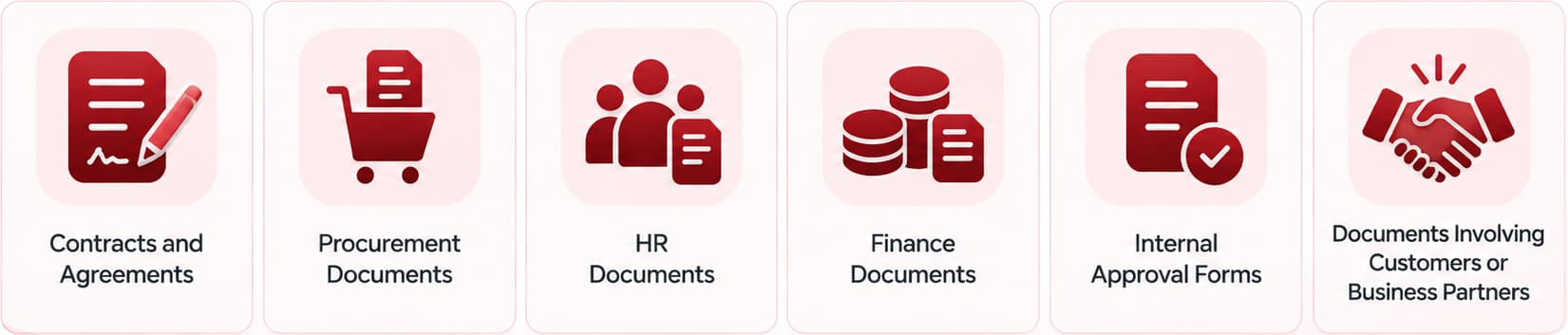
From there, a company can map out how its signing process actually runs.
For instance, whether signing is already integrated with the applications in use, how the signer's identity is verified, how document integrity is maintained, and whether signing activity can be traced back.
This approach helps a company see digitization not merely as a project to cut down on paper, but as an effort to build a more connected process with the level of control the business actually needs.
Digitization Should Change the Process, Not Just the Document Format
Turning a physical document into a digital one is the first step. But transforming the process requires attention to what happens after that document is created.
How does the document get approved? How is the signing done? How is the signer's identity verified? How is document integrity maintained? And how can signing activity be traced back when it's needed?
This is where a Certified Electronic Signature can become one component within a company's digital workflow.
With a verified signer identity, preserved document integrity, provable consent, auditability, and the ability to integrate through an API, a company can build a signing process that is more connected to its digital business needs.
Indocyber provides a PSrE-based Digital Signature solution to help companies strengthen their signing process and integrate it with their digital system needs.
Learn About Our PSrE-Based Digital Signature Solution!
Want to know how a Digital Signature can be applied to your company's existing process and systems?
[ Consult with our team now! -> Certified Digital Signature ]
Get the latest technology and business transformation insights from Indocyber.