



IT Outsourcing vs In-House Team: Which Is More Efficient for Financial Institutions?
The question of whether to build an in-house IT team or partner with an outsourcing provider remains an ongoing discussion across the financial industry.
It's not a question of which is "better" in absolute terms, it's about which is more efficient for your institution's specific context, scale, and priorities. And the answer requires a deeper calculation than simply comparing salary costs against contract fees.
This article provides a comparison of both approaches.
What Are We Actually Comparing?
Before getting into the numbers, it's important to agree on definitions. "In-house IT team" isn't just about salaries. And "IT outsourcing" isn't just about vendor contract fees.
The relevant comparison is Total Cost of Ownership (TCO), the true total cost incurred over a given period, including costs that are often invisible.
Three Hidden Costs That Are Often Overlooked
1. Turnover and Recurring Recruitment Costs
In Indonesia's IT industry, the average engineer tenure is around 18–24 months before moving on. Every time an engineer leaves, the institution absorbs recruitment costs (3–6 months of salary), onboarding costs, and the opportunity cost while the position is vacant. In the BFSI sector, which requires specialists with knowledge of OJK regulations, these replacement costs are even higher.
2. Ongoing Training and Certification Costs
Technology moves fast. Internal IT teams need continuous upskilling, cloud certification, cybersecurity training, compliance updates. These costs are often absent from initial budgets but occur regularly every year. A professional outsourcing partner absorbs these costs internally and reflects them in service quality, not in additional invoices to the client.
3. Infrastructure and Licensing Costs
In-house IT teams require tools, software licenses, and self-managed infrastructure. Outsourcing partners typically already maintain a configured technology stack that clients can access without additional CapEx. In the cloud era, this gap is increasingly significant.
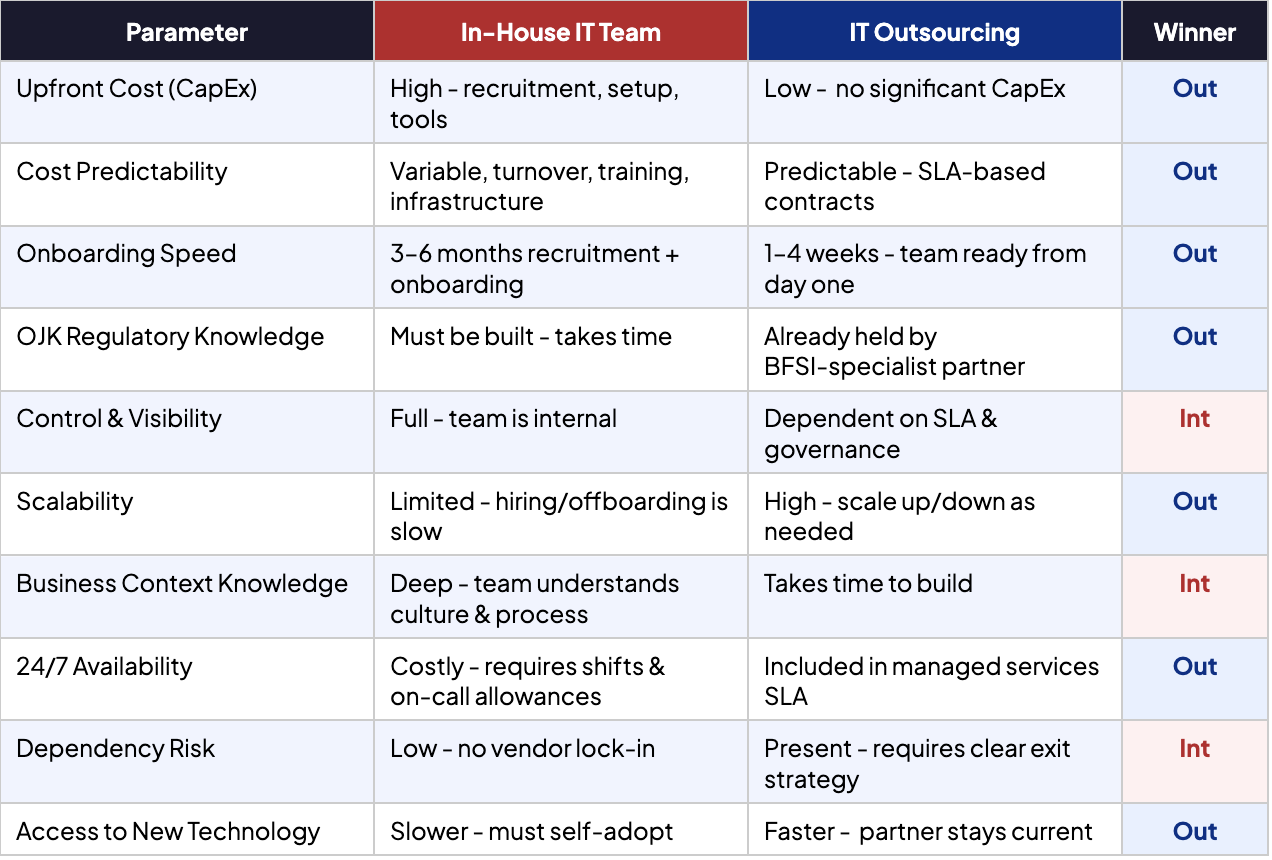
Side-by-Side Comparison: IT Outsourcing vs In-House Team
When Does an In-House Team Still Make Sense?
IT outsourcing isn't a universal answer. There are conditions where maintaining and strengthening an in-house team is the right strategic decision.
- Functions that are core competencies, for example, a product IT team building competitively differentiating features. These should not be outsourced because the knowledge must stay internal.
- When the institution has sufficient scale to achieve economies of scale a large, fully specialized IT team where the per-head cost is already efficient.
- For functions requiring the highest level of confidentiality and access to highly sensitive data where internal governance is easier to control.
When Is IT Outsourcing the More Efficient Choice?
- Operational functions that are critical but not differentiating, helpdesk, infrastructure, monitoring, patching. These are ideal to outsource because a partner can execute them more efficiently through their own economies of scale.
- High-specialization needs that are difficult to hire for cybersecurity analysts, cloud architects, IT compliance specialists. It is more efficient to access this expertise through a partner than to build it from scratch.
- When the institution needs to move fast launching a new system, meeting a compliance deadline, or responding to an incident. An outsourcing partner can mobilize within days, not months.
- When the IT budget needs to be tightly predicted a fixed OpEx model per period is far easier to budget than the variable costs of an in-house team.
The Most Widely Adopted Model: Hybrid
In practice, Indonesian financial institutions that are mature in IT management tend to adopt a hybrid model, rather than choosing one or the other.
The logic is straightforward: retain an internal team for strategic functions and core competencies. Leverage an outsourcing partner for operational functions, high-specialization needs, and variable capacity requirements.
This model delivers control where it matters most, and efficiency where it can be optimized.
Five Questions to Evaluate Your Options
Before deciding, answer these questions honestly:
- Is this IT function a core competency that differentiates your institution from competitors?
- What is the true total cost of an in-house team, including recruitment, training, turnover, and infrastructure, over the next three years?
- How quickly does your institution need to respond to OJK regulatory changes, cyber threats, or new business requirements?
- Can you compete with fintechs and tech companies to recruit the best IT specialists?
- What would you do with the resources freed up if some IT functions were managed by a partner?
Indocyber: IT Professional Services Partner for Financial Institutions
PT Indocyber Global Teknologi helps Indonesian financial institutions design the right IT model, whether that means strengthening an in-house team, building an efficient outsourcing engagement, or designing an optimal hybrid model for your institution's specific context.
Learn more about Indocyber's IT Professional Services by clicking this link: https://www.indocyber.co.id/product-solution/layanan-it-profesional